The Archers Were Never Too Strong. They Were Too Fast.
Development period: October 25–26, 2026. The simulator and the balance changes below were built with Claude (Opus 5.5, in Claude Code) at my direction. Unlike the Attrition simulations, this one is preserved: it lives in the Lanes repository, it is seeded, and npm run sim reproduces the figures. The data behind every number here is published alongside this post.
Play Lanes · Source · The directory
A year of not finishing, and then a month of building
Lanes began as an empty repository in November 2025 with one idea in it: I wanted my own version of Grand Kingdom, the PS4 and Vita tactics game where squads fight across three lanes and attacks hinge on timing.
In February it became a Godot 4.6 project with its first six classes. In September I threw that away and rebuilt it as an Angular PWA, because everything else I make lives in the browser and I wanted to play it on my phone. The last week of September and all of October were when it turned into a game. The repository went from twenty commits to sixty-nine:
- a Three.js battle stage with rigged characters, and timing bars on every attack;
- six classes across a melee, ranged, and magic triangle, with knockback and melee reach;
- a mercenary roster with levels, aptitudes, skill patterns, and pair bonds that earn perks;
- a guild hall, contracts, equipment, a forge, and facilities to spend gold on;
- an overworld board, three regions, and a ten-mission story;
- siege engines, barricades, traps, and a Fighter’s shield that actually blocks.
That is a lot of numbers to get wrong. I could feel some of them were wrong. I could not tell which ones.
Making the game play itself
The battle rules in Lanes are plain TypeScript, separate from the screen, and the enemy AI already knew how to play. There was even an auto-battle button that let the AI play your side. So the simulator turned out to be mostly a harness: start a battle with no screen attached, turn on auto-battle, fast-forward the clock, and write down what happened.
A battle takes about three milliseconds. The latest run fought 22,050 battles in 61 seconds:
- random four-against-four squads of every class, and mirror matches where both sides field the same squad;
- guild contracts at squad levels 1, 4, 8, and 12, at every difficulty tier, with and without armoury gear;
- every story mission, fought by a random squad at that mission’s level.
One thing the AI can’t stand in for is a person’s thumb. In Lanes, ranged attacks are fired from a sweeping cursor and melee attacks chain into combos, so timing changes damage. So the simulator fights every contract and story battle as three kinds of player, a Novice, an Average, and an Expert, each with its own odds of a critical, a graze, or a Just Cancel. Those odds are my guesses, not measurements. They are written down in the repository so they can be corrected once real people play.
The first thing it found was that it couldn’t finish
Before I’d asked a single balance question, the first 250 battles turned up two bugs.
The player always went first on a tie. Turn order sorts by Speed, and when two units tied, the player’s unit happened to be first in the list. Going first matters more than I realised, and in mirror matches the player side won seven times in ten. Ties now break on Agility, then alternate between the sides, starting from a coin drawn from the line-up. It’s a coin with no dice in it, so the same battle always plays the same way. Mirror matches came back to 45–50%.
One battle in twenty never ended. Sometimes an AI unit wanted to change lanes, but someone was standing level with it in the next lane, so the move was refused. It tried again the next turn, and the turn after that, forever. Other times two Clerics would chip three points off each other while their Guard soaked the rest and their heals undid the difference. The AI now steps aside along its lane before switching. Battles also end after twenty rounds, won by whichever side has more of its strength left. The attacker has to do strictly better, so a draw goes to the defenders. Since then, no simulated battle has failed to finish.
The archer problem
With the sides fair, the first real balance question had an obvious answer. Squads that fielded an Archer won 66% of random battles. Every other class sat between 47% and 50%.
My first instinct was that Archers hit too hard, or reached too far: Piercing Arrow can target anyone in any lane. So we tested each suspect on its own, 1,500 battles per variant:
| Change | Squads with an Archer win |
|---|---|
| As shipped | 65% |
| Piercing Arrow loses its cross-lane reach | 61% |
| Archer attack 75 → 60 | 52% |
| Archer speed 75 → 58 | 46% |
| Every other class +12 speed | 51% |
The reach barely mattered. Speed was most of it. Archers are the fastest class, so they act first, and the side that acted first won 71% of all battles. A first volley in Lanes decided most fights before the slower units got a turn.
That also explained why the obvious buff was a trap. Speed in Lanes only decides the order of turns, not how many you get. Making everyone else faster just handed the first volley to whoever became fastest. In that test it was the Lancers, who rose to the top.
I leaned toward buffing everyone else rather than nerfing the Archer. Extra attack for the other classes made things worse: battles got shorter and first volleys got deadlier. What worked was giving them more health, so that a first volley wounds instead of wins:
| Change | Archer squads win | First mover wins | Average rounds |
|---|---|---|---|
| As shipped | 63% | 67% | 3.4 |
| Others +10 attack | 62% | 66% | 2.5 |
| Others +25% HP | 56% | 58% | 4.1 |
| Others +40% HP | 51% | 51% | 4.6 |
So every class but the Archer got about 40% more HP. The Fighter went from 180 to 250, the Lancer from 130 to 180, the Cleric from 120 to 170, the Gunner from 100 to 140, and the Witch from 90 to 125. The Archer stays at 110 and is now the frailest class in the game, which feels right for someone whose whole job is to shoot first.
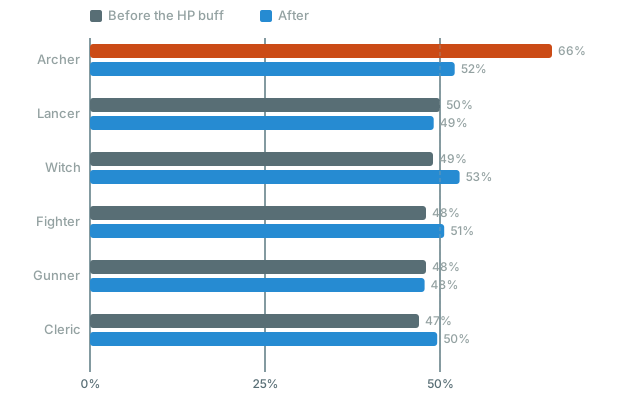
In the latest run, squads with each class win 48–53%. The first mover wins 54%, battles last about five rounds instead of three or four, and 7% of random battles now go the distance to the round limit.
A story with its finale in the wrong place
The story was the part I’d tuned by feel, and it showed. Here is the win rate for an average player with armoury gear, mission by mission:
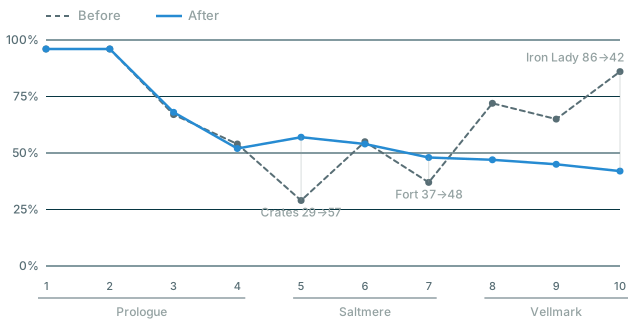
Two missions were walls, and the finale was the easiest battle since the tutorial. The simulator told us why for each one:
- The Seal on the Crates (29%): the enemy barricade did most of the damage. It’s gone, and the dock wardens now fight a level below the mission. Now 57%.
- Storming Saltmere Fort (37%): the enemy catapult could hit any lane. It’s now a ballista aimed down a single lane, so you can see the danger and cross it. Now 48%.
- The Iron Lady (86%): by level 10 your squad wears mythril from the armoury, and story enemies wore nothing at all. I had added equipment and never handed any to the villains. Lady Iselde now fights five levels above the mission, her household three, and all of them wear mythril. Now 42%.
Then the two Vellmark missions before the finale were the new bump, at 72% and 65%. Their bands now wear iron and steel, and Brann Ironside fights three levels above his assault. The curve from Saltmere to the end now reads 57, 54, 48, 47, 45, 42, a steady climb with a small breather where each new chapter begins.
Different players feel the finale differently: Novice players win it about 31% of the time, Average 37%, and Expert 54%. Without equipment the late game is much harder: 18–36% for the finale. That gives the armoury a real job.
Guild contracts, and what timing is worth
Contract tiers came out roughly where their names promise. With armoury gear, averaged over squad levels:
| Tier | Novice | Average | Expert |
|---|---|---|---|
| Easy | 88% | 92% | 94% |
| Normal | 56% | 60% | 72% |
| Hard | 31% | 40% | 47% |
Without gear, Normal drops to 30–45% and Hard to 14–25%. Equipment matters more than timing skill, which surprised me a little. Going from novice to expert timing is worth about fifteen points on a hard contract, while showing up in armour is worth about twenty.
What the simulator says about achievements
Lanes doesn’t have achievements yet. That’s deliberate. After Attrition, I’d rather know how rare something is before I promise it to anybody. So the simulator also counts how often a handful of candidate achievements would unlock, across every contract and story battle:
| Candidate | Rule | Novice | Average | Expert |
|---|---|---|---|---|
| Heavy Hitter | One blow of 150+ damage | 37.3% | 41.1% | 45.7% |
| Blitz | Win within 2 rounds | 24.2% | 30.0% | 37.7% |
| Shield Wall | Your shields block 60+ damage in one battle | 27.7% | 25.6% | 22.6% |
| Flawless | Win without losing anyone | 18.1% | 21.6% | 26.9% |
| Reaper | One mercenary fells 3 enemies | 11.7% | 13.6% | 16.5% |
| Just Right | 3 Just Cancels in one battle | 3.4% | 12.1% | 31.9% |
| Sharpshooter | 3 critical shots in one battle | 1.2% | 8.3% | 30.9% |
| Nail-Biter | Win with under 25% of your strength left | 5.4% | 6.2% | 7.4% |
| Last One Standing | Win with one mercenary left | 3.7% | 4.2% | 5.0% |
| Sheltered | A guarding Fighter covers allies twice | 2.8% | 2.7% | 2.3% |
| Hold the Field | Win when time runs out | 2.6% | 2.3% | 2.0% |
A few of these already tell me something:
- Heavy Hitter, Blitz, and Shield Wall happen in a quarter to a half of battles. They’re tutorials, not trophies. The biggest single blow reaches 141 damage in half of all battles and 252 in one in a hundred, so if I want a rare damage milestone, it lives up there. (Most of that comes from Meteor, which averages 465 damage per cast and doesn’t care whose side you’re on.)
- Sharpshooter and Just Right are the only ones that really reward skill: about 1–3% for a novice and 31–32% for an expert. Those are the achievements that mean “you got good at this.”
- Sheltered is rare, and probably for an odd reason: the AI rarely seems to end up with a guarding Fighter in front of a friend. A person who learns the shield rules should see it far more often than the simulator does, which would make it a nice reward for reading the manual.
- Shield Wall gets rarer for experts, most likely because better players win faster and their Fighters block fewer blows. Thresholds that measure endurance can run backwards against skill unless I’m careful.
What the numbers are, and what they aren’t
These are design numbers, good enough to make decisions with. They are not a study:
- The AI plays your side. It doesn’t plan, bait, or flank the way a person does. Real players will do better on some missions and worse on others.
- The timing profiles are guesses. Novice, Average, and Expert are odds I made up. Real play is the only way to correct them.
- Each figure comes from 150 to 600 battles, so differences of three or four points are mostly noise. The mirror matches show it: depending on the run, the player side wins 44% to 49%. About one point of that comes from the round-limit tie rule. I haven’t pinned down the rest yet.
- The squads are random. Players don’t build squads at random, and once they find a favourite, the class numbers will drift.
What is different from Attrition is that this time it’s all reproducible. The simulator, the seeds, and the scenarios are in the repository, and the data from this post is here, next to the class, contract, story, and achievement tables from the latest run.
Next
The achievements come next, now that I know which ones are trophies and which are lessons. After that I’d like Lanes to tell me how real battles go, the way Attrition does, so the simulator has something to be wrong about.
If you play it, you are the part of the model I couldn’t simulate.
This post was drafted by Claude Opus 5.5, Anthropic’s AI model, at my request, from the simulation data and the development history.
— Chris